
Wednesday, March 31, 2010

“‘May the story bring you what you seek’”

Aaron A. Reed’s interactive fiction (IF) piece, “Whom the Telling Changed,” is about a tribe that has to make a decision about how to handle the newcomers to their land; whether to fight them or to talk to them. “Whom the Telling Changed” tells about the journey that the tribe goes through and how different characters are affected by the decisions of a few. The IF, although that it is written as a fictional story, really makes the interactor think about their own choices in life and the choices of others around them, especially those choices made by people in power.
There are quite a few ways that “Whom the Telling Changed” can be understood, since it depends on the type of person that the interactor is; if the interactor is a pacifist (or trying to set the player character on a certain path in the game) the IF will have a different ending then if the interactor is more warlike. Each of the different possibilities that are in-between the two spectrums are also accounted for in the final situation of the IF. In my own interaction with “Whom the Telling Changed” I seemed to take the more pacifist route in the IF or at least more so leaning to that side in comparison to the more warlike side.

The opening of “Whom the Telling Changed” started off giving the interactor brief instructions on how to interact with the IF, which is helpful to the inexperienced interactor. After going through the instructional screens, the IF looks like the screenshot at right. From that screenshot, I looked around the tent and noticed the medicine bag and copper dagger,
but then I could not figure out what to do next so I went around the tent examining each the different items in the tent and finally realized that I could go outside and received the following output: After which I commanded the player character (the character that the interactor is playing/telling what to do) to pick up the first dagger and then the medicine and to leave the tent.
After going outside the following exchanges took place. During this contact with Sihan and Saiph, the interactor chooses who their lover is and who is the enemy. This allows for different choices and undertakings to take place in the rest of the IF. In my session, I, as is seen in the pervious screenshots, made the unknown decisions to have Sihan (female) as my lover and Saiph (male) as my enemy.
Following the contact with two non-player characters (Sihan and Saiph), Sihan and the player character go to the village’s firepit and I talk to Isi, who is the player character’s aunt. Isi tells the player character that he has to give the circlet of office to the storyteller, which leads the interactor to another decision that has to be made in the game: who is the storyteller? In my interaction with the IF, I gave the circlet to Nabu, the player character’s uncle.
Once the player character gave the circlet to Nabu, Sihan came over and talked, but soon left since she likes “to hear the stories by herself” (Reed).
After Sihan leaves, Nabu asked the villagers if they were ready to hear the story during the time of needed guidance with the decision pertaining to the newcomers.


For the next 56 cycles, which is “one input and all the output that follows it until the next input” (Montfort 25), Nabu tells the story, with a few interruptions from the villagers, mainly Saiph, but after the intermission of the story telling (once I figured out that I could make the player character talk during specific points of the story due to the words that were listed in the header of the window), Saiph and the player character both talk for the last part of the story.
The story that Nabu recites and shows to the audience in their minds is that of the adventures of Gilgamesh (King of Uruk), Enkidu (Gilgamesh’s friend and companion), and how their gods played a role in the events in Gilgamesh’s life. The story, before the intermission, tells about Gilgamesh and the gods’ gifts to him of life, courage, and leadership skills. When the story turns to talk about Enkidu, Saiph asks Nabu about the friendship of Gilgamesh and Enkidu, which seemed to me as I was playing the game foreshadowing an outcome of the IF, especially since I have yet figured out how to ‘talk’ during the story.
The next part of the story or basically the real plot of the story is the challenge that one of Gilgamesh’s gods’ makes him, to which Saiph asks about the monster that Gilgamesh is challenged to kill. So Gilgamesh and Enkidu set out to kill the monster, although that Enkidu does not want to kill the monster. Nabu goes on to tell about the making of their weapons, the sacrifices, and the travel of the two warriors to the Cedar Forest. While Nabu goes on to tell about the travel, the intermission part happens when Saiph comes over and talks to the player character

where, during my session, they seem to form a fragile treaty to do the best thing for the tribe rather than just whatever they feel like doing.
After the intermission, I command the player character to talk in response to the story. Below are some of the examples:


Soon after the warriors reach the monster, Humbaba, where they fight, and threw a net over it and captured it, but it asked Gilgamesh not kill it


Gilgamesh was unsure what to do, but before the storyteller is able to finish the story, the newcomers enter the IF

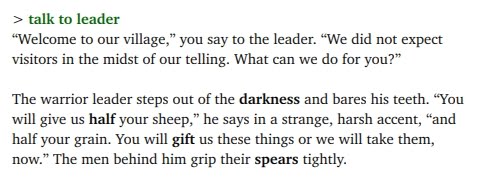

At this point in time the pervious choices that the interactor chose through the IF come into play. In my session, Saiph ends up laying down his spear, which the leader of the newcomers does not, but they talk - no fighting happens, at least I am lead to believe since it seems that my player character fainted or was knocked unconscious because my cycle went from talking to the newcomers to waking up and no one was around.


There are few puzzles in “Whom the Telling Changed,” most likely because it is not a puzzle-based IF, but more as a story-based IF. The deference between the two IF forms are that puzzle-based IF has many various puzzles that the interactor has to figure out in order to be able to further themselves in the IF. An example of puzzle-based IF would be “All Roads” by Jon Ingold, where the interactor has to figure out how to get out of a room and get past a guard in order to go anywhere or do anything in the game. A story-based IF, like “Whom the Telling Changed,” is mainly driven by text seen by the interactor during a session of IF. I feel that if “Whom the Telling Changed” was made into a puzzle-based IF, it would not have been as good as it is in the story-based IF format. The few puzzles that are in the IF are simple puzzles like what to grab as the player character’s symbol, who is going to be who in the player character’s life, and who to give the circlet to. With the few puzzles in the IF, it allows it to be more of a literary piece of art work than a digital.

In my traversal of the IF seemed to go all right throughout the whole of the IF, once I figured out the little differences mentioned above. One thing that I did not care for about the IF was how I went from standing there talking to the newcomers to being passed out near the firepit. I really enjoyed playing “Whom the Telling Changed” since it leaves its interactors reflecting on their own lives since, unless the interactor is trying to bring the player character down a certain path, the choices come from the interactor’s own personal feelings. The story-based IF format of “Whom the Telling Changed” works really well and allows for the interactors to gain the most from this labor of love that Aaron Reed put together.


Works Cited
Ingold, Jon. “All Roads.” .
Reed, Aaron. “Whom the Telling Changed.” .
Montford, Nick. “Twisty Little Passages: An Approach to Interactive Fiction.”
Cambridge, Massachusetts: The MIT Press, 2003.

Wednesday, March 3, 2010

A Creative (and Aggravating) Journey

Using Microsoft Office Power Point to try and make a flash poem was an interesting experience to say the very least, but yet it was also fun. The hardest part about creating the flash poem, at least for me, was what poem best suited the genre of flash poetry. I went through various poems that I have written before (and one I tried to write in cento form), but in the end I settled on my poem entitled, “Ribbons.” The reason that I found it so difficult to pick a poem was due to the fact that what I imagined the flash poem to look like, did not turn out the way I wanted it to when using Power Point, most likely because I was learning the different functions of the software. One poem that I tried to create as a flash poem was called, “Castles in the Air,” a poem that I had written for a pervious class and thought it would make a good flash poem. What I soon found out was that I had too high of expectations of what I wanted to create because of all the images that were threaded into the poem. Although that I did not continue with “Castles in the Air” as a flash poem, it might a poem that I might go back to and try working with again. Here are a few screen shots of the part of the poem that I did work on:


This shows the movements that the different images took when the poem is animated.


“Ribbons” seemed like my best choice to use in this medium because of the way the poem flows and the imagery that is used in the poem was easy to recreate in the Power Point. Here is the title screen of the poem:

The background, though I change a few of the color lengths, is called horizon on Power Point, and gives the understanding to the poem that I hoped for; it portrayed earth which I though was suiting for the poem because of the various images that are present in the poem.

The next slide of the poem, which shows the first stanza of the poem,
which when animated, the words float onto the page like ribbons that are floating effortlessly in the breeze and then are slowly swept off the page, after staying a small amount of time for the reader to read the lines. I hoped the reader would find the imagery of the words moving slowly and peacefully across the page as help to understanding what the stanza is trying to saying about the white ribbon. I used the background to help the reader understand the air imagery in the stanza and how a clear blue sky often denotes good, clean, innocence things, like watching the clouds change shape when the reader was a child (or to this day). Also the slowness of the movements and simplistic colors (white) would give the reader thoughts of times that were easier and still being innocence to the world.

The next slide/part of the flash poem is a bit faster past then the pervious slide, just because of the imagery of the stanza.
The faster pace of the poem and lines, which enter the page in similar fashion, but move more like swimming in water, denotes to the reader that there is a sense of urgency to the stanza. The blue background gives the reader the representation of water and the pink text on the screen shows that text has stepped away from the innocence that was shown in the pervious stanza. This time the reader understands that the poem is narrating the speaker’s search for something, but they do not know what exactly they are searching for among the ever changing waves/moments of life.

The third stanza, when animated, comes in fast because the lines are representing fire imagery, as is shown by the words themselves and the background. Through the lines the speaker is trying to show the passion that they are feeling, the all consuming fire that comes from finding the answer to the pervious stanza. The lines come in fast because when one experiences something that takes hold of their full conscience, whether it be a class, paper, an event, or just something happening in a person’s life, things seem to either fall in place or are chaotic - those thoughts are foremost in a person’s mind and everything else seems to slip by and not matter as much as it once did. The lines come in rotating, standing for the flames of fire and the chaotic feelings that is going through the speaker’s mind during this part of the poem. When the lines leave the page, they leave the top of the page, symbolizing smoke and getting the reader ready for the next stanza of the poem.

The last stanza of the flash poem is quite different from the rest of the slides in the way that it is dark in coloring. The dark coloring of the background and text symbolize the delving of the black ribbon into the dirt. When the lines come onto the screen, they come in fast, as if they are trying to get through the thick, dark earth, but stop abruptly on the screen, and then continue to move slowly down, revolving as they go down to symbolize the death and end of the ribbon.

There are many different meanings that the ribbon(s) could symbolize, but when I was writing the poem, I saw the ribbon as a physical item to represent love. The white ribbon stands for innocence, the innocence that one has before they ever know the love of a boyfriend/girlfriend. The pink ribbon stands for the slight lost of innocence that one loses just by knowing that the love they have might not be as true as they think and also it stands for the searching of what true love it, since to find true love, normally, one is hurt. The red ribbon is the passion that takes place in a relationship, non-sexually. The passion is finding the true love, or what one thinks to be true love, and being happy in the relationship. The black ribbon is the death of the relationship. One just wants to get away from all of the innocence of the sky/water and the passion of the fire, and be in a place that nothing can reach them. This is what I hope the lines and the animation describe in the poem, “Ribbons.”

There are many different meanings that the ribbon(s) could symbolize, but when I was writing the poem, I saw the ribbon as a physical item to represent love. The white ribbon stands for innocence, the innocence that one has before they ever know the love of a boyfriend/girlfriend. The pink ribbon stands for the slight lost of innocence that one loses just by knowing that the love they have might not be as true as they think and also it stands for the searching of what true love it, since to find true love, normally, one is hurt. The red ribbon is the passion that takes place in a relationship, non-sexually. The passion is finding the true love, or what one thinks to be true love, and being happy in the relationship. The black ribbon is the death of the relationship. One just wants to get away from all of the innocence of the sky/water and the passion of the fire, and be in a place that nothing can reach them. This is what I hope the lines and the animation describe in the poem.

The software, once I played around with it a little and had help from Dr. Liu and Shauna, who was sitting next to me, I found using Power Point was fun, though stressful at times when things would not want to work the way I thought they should. Using Power Point and adding in details to the poem that would not have been possible on paper, I believe, will help readers understand the poem better. It will be interesting later in the semester, after I finalize the animation of the flash poem, since I am hoping to add music that my friend is going to help create just for “Ribbons.” It should be interesting to see if my Power Point experience will change… Overall creating my own flash poem has really opened my eyes to the amount of work that creators of other flash poetry must have gone through to get their poems to the finished stages that are perfect. It brings a whole new level of understanding and awe to this new genre of literature.

Wednesday, February 24, 2010

Rhinoceri and Faith


When a user first opens “The Dancing Rhinoceri of Bangladesh,” what they see is not that impressive (see screen shot at right), since all there is a picture of a rhinoceros, the title, author - Millie Niss, and start. After clicking ‘start,’ a new window pops up and traditional Indian music starts to play. Written in pink letters is: “this is the title of the poem” (Niss). As there are no instructions for this poem, the user most likely will wave the mouse around on the page and hear a whole lot of noise. The noises that the user hears are voice recordings of many different sentences. Through all of the noise the user might hear: “by moving the mouse slowly you’ll get more out of it” (Niss), which the sentence that you would hear if the user of the poem placed the cursor over the word ‘by.’ There are other similar words to ‘by,’ that when the cursor is placed over them, they will revel a spoken message. The words are: ‘are,’ ‘is,’ ‘the,’ ‘they,’ ‘it,’ ‘a,’ ‘this,’ ‘you,’ ‘isn’t,’ ‘in,’ ‘an,’ ‘aren’t,’ ‘of,’ and ‘to.’
Another thing that the e-poem does that takes a little time to figure out is that when the cursor goes over different words in the poem, like ‘frogs,’ the user will see other words turn pink, and turn it into a poem. ‘Frogs’ would read: “frogs
legs in butter sauce annoy activists” (Niss), which the user would change ‘frogs’ to frog’s within there mind to show the possession of the legs to the frogs. Different examples of these word choices are shown in the screen shots. Each different word adds a little more to the interactive poem, since the user can create their own poem using the poem created my Niss, just by changing around the order of the way they read the words/sentences or hear them being played.
“The Dancing Rhinoceri of Bangladesh” is a hard poem to read from start to finish because of the many different ways that someone might reader the poem. The poem seems to be a lot of nonsense sentences, but yet what one of the words, ‘it’ says, makes sense in the poem, “it sounds like newspaper headlines” (Niss). It is almost as if the speaker of the poem read headlines one day and the poem is the path that their thought process led her to explore. Each of the lines in the poem, whether written or spoken, have a certain music to them that makes the reader want to keep reading, even though it might seem a little abstract. The poem is interesting to the reader in that you never really have to read the same poem twice, because of the changing lines that make up the poem’s identity.
“The Dancing Rhinoceri of Bangladesh” is one poem that is a good example of what N. Katherine Hayles says in her essay, “Electronic Literature: What is It?,” “Electronic literature tests the boundaries of the literary and challenges us to re-think our assumptions of what literature can do and be” (Hayles 2). “The Dancing Rhinoceri of Bangladesh” is a good example because it is not a poem that was written first then put into an electronic setting, it was a first generation e-poem and it challenges its readers to really look deep into its words and meanings and see the “hopeful monster” (Hayles) that is waiting to be found and shared with others. Also it is just waiting for the right time to become a normal, accepted type of literature.

“Faith,” by Robert Kendall, from its opening page (see screen shot at left) is interesting to the reader. It gives the authors description of the poem and how to interact with it, which is very helpful to the reader well experiencing electronic poetry, especially for the first time. Also the opening page has a screen shot from the poem itself, which intrigues the reader to want to know more about the poem. Once the reader clicks ‘begin,’ it brings the reader to the poem’s title page, and after clicking ‘Faith,’ a new window opens with the picture that was on the opening page of the poem. On this new page, the reader can choose to experience the poem with or without music. After clicking one or the other and begin, the poem opens before them.
The poem opens with xylophone notes being played as the word ‘logic’ hits Faith and bounces off of the word/title. The poem, once the words that are in a yellow-orange color fly into the screen, reads: “logic can’t bend this” (Kendall) and at the bottom of the screen (see screen shot at left) is the word “So…” (Kendall), which bring the reader to the next screen. The red-orange words are flown in with accompaniment from a harp to add to the pervious part of the poem: “I edge logic out. Can’t the mind press on around the bend to consummate this vision of the deep ‘or’?” (Kendall). At the bottom of the page says, “Maybe. But…” (Kendall), which leads to the next page where a mixture of violin and horn, music, along with the clicking of a button and something sliding against a rough surface, herald the brownish-red words on to the screen. These words push out some of the other letters and words from the pervious two screens to be able to fit themselves into the poem, as is shown in the screen shot at left.
The next screen has the words appear in black to finish the rest of the five stanza poem. The words come in with a score of sounds from the pervious words coming into the poem: xylophone, harp, violin, and horn. During this addition of words, when some of words that denote leaving like, “walking out,” “leave taking,” “forgoing-going-gone,” and “stride out” (Kendall), the words depart, leaving a faded color of themselves behind. The last word of the poem, as it would be at this point of the poem (screen shot at left)
is ‘Leap,’ which almost literally leaps off of the screen by growing bigger and bigger as it leaves the screen. The final screen is that of most of the words that were on the screen, falling down to the bottom of the screen with xylophone notes flowing them down and having Faith fall gently down on the words at the bottom. The words that are left visible at the end of the poem are: “just to sum up: Faith” (Kendall).
“Faith” is an easier poem to be able to look at, compared to “The Dancing Rhinoceri of Bangladesh,” because of the text and even though it changes, it moves in such a way that the reader is able to understand, make sense, and follow the poem from beginning to end. The language of the poem, especially the first few words, “logic can’t bend this” (Kendall), hold such power in them. The poem basically is saying that the speaker of the poem can not make sense anymore of the thing events that are taking place around, so they are going to step blindly out of their comfort zone and into the unknown, which holds the things that the speaker is wondering about in their life, why everything happens. This is shown through the lines, “I’ll simply stride out of my mind, press my foot firmly / into the black, all-but-bottomless chasm beyond the brink, / around the bend, off the rocker (yippe!), to leave behind / only this consummate poem, this visionary, incorruptible / transcript of the deeper world’s One True Word: / Leap” (Kendall). The lines tell the reader that the speaker leaps into the chasm, but as the next screen depicts, Faith lands gently on top of the other words that were talking about logic; Faith wins the speaker’s thoughts and heart over logic. This is also shown in the very beginning of the poem, where logic is bouncing off of Faith because logic and faith usually do not coincide with one other when using logic in the scientific meaning.
I feel that the two poems almost have to be in the e-poem format for them to be able to make sense to the reader. “Faith” would be able to be written down and read on a flat piece of paper, but then the reader looses the experience of the words when they are flying about the screen, pushing other letters out of the way, and the sounds that make the poem cute. All of the little ‘extras’ would be lost if it was just written on paper. “The Dancing Rhinoceri of Bangladesh” has to be shown through the medium of e-poetry because of the interactive nature of the poem and the sound that is present in the poem. Without the interactive nature of the poem, “The Dancing Rhinoceri of Bangladesh” would just be a bunch of words that do not make that much sense when read together. Also with having it be interactive, the poem keeps going allowing the reader to find new word choices with each mouse movement. The reader of these two poems is better off reading them electronically than on a simple, flat, white page of paper.

Works Cited

Hayles, N. Katherine. “Electronic Literature: What is It?” The Electronic Literature Organization, 2 Jan. 2007. Web. 1 October 2009.

Kendall, Robert. “Faith.” “Electronic Literature Collection.” ed. N. Katherine Hayles, et. al. October 2006. Web. 24 February 2010.

Niss, Millie. “The Dancing Rhinoceri of Bangladesh.” “Word Circuits.” ed. Robert Kendall. September 2002. Web. 24 February 2010.

Wednesday, February 3, 2010

Initial Reactions


My initial response to e-poetry based on the pieces assigned so far is that this field is intriguing, but might take a little while to get use to working with. The poems that were apart of the first assignment gave me a good idea of the basics of electronic poetry and how it is going to differ from reading poetry in a book. The first main difference is that electronic poetry is interactive and grabs the reader’s attention more quickly than a page of text would. Electronic poetry has movement, pictures, color, backgrounds, and sound, which allows the reader to gather a different understanding of the poem than if they had just read it on a page. Also having ‘extras’ in the poem, like pictures and sound, gives the reader an idea of what the creator of the e-poem, who is not necessarily the poet, is trying to depict about their particular understanding of the poem. E-poetry allows for two different people to use the same poem, but create two completely different e-poetry readings, just by the different uses of color, pictures, sound, and type of interaction.
The poems that were used in the first assignment were: “The Best Cigarette” by Billy Collins, “Nine: puzzling through several lives” by Jason E. Lewis, and “A Man Young and Old: III. The Mermaid” by William Butler Yeats. “The Best Cigarette,” I felt, gave the poem an extra edge to it because it was being read to its audience, which allows for a certain understanding of the poem just because of way that certain words were spoken and/or stressed, giving the poem’s listeners’ a look into the way the reader understood the poem. Also in this poem, the pictures of cigarettes, wine glasses, and the typewriter pretending to be a train in the background added to the poem and did not take away from the speaker. In “Nine,” I liked the way it used the form of a sliding puzzle to hide the words of the poem, which gave it a deeper meaning in the way that poem was about understanding lives and you have to figure out the sliding puzzle to finish the poem and understand life. Also I liked that when you held down the left mouse button on a puzzle piece, the picture would change. “The Mermaid” was just the poem’s title on a magenta background, with nine copies of the poem around it, going in different directions. I did not care for this e-poem as well as the others since it did not add anything to the poem, it was just mainly interactive.

I believe with time, I will really like electronic poetry and just not appreciate it.

The picture was taken from the e-poem of Billy Collins's "The Best Cigarette" and shows the typewriter pretending to be a train that is meantioned in the second paragraph.